Baking & Sweets
Watermelon Granita’s Ice-Crystal Alchemy
Pamela Anderson’s four-ingredient frozen dessert trades a machine for a fork and a 9-by-13 pan for a crystalline finish.
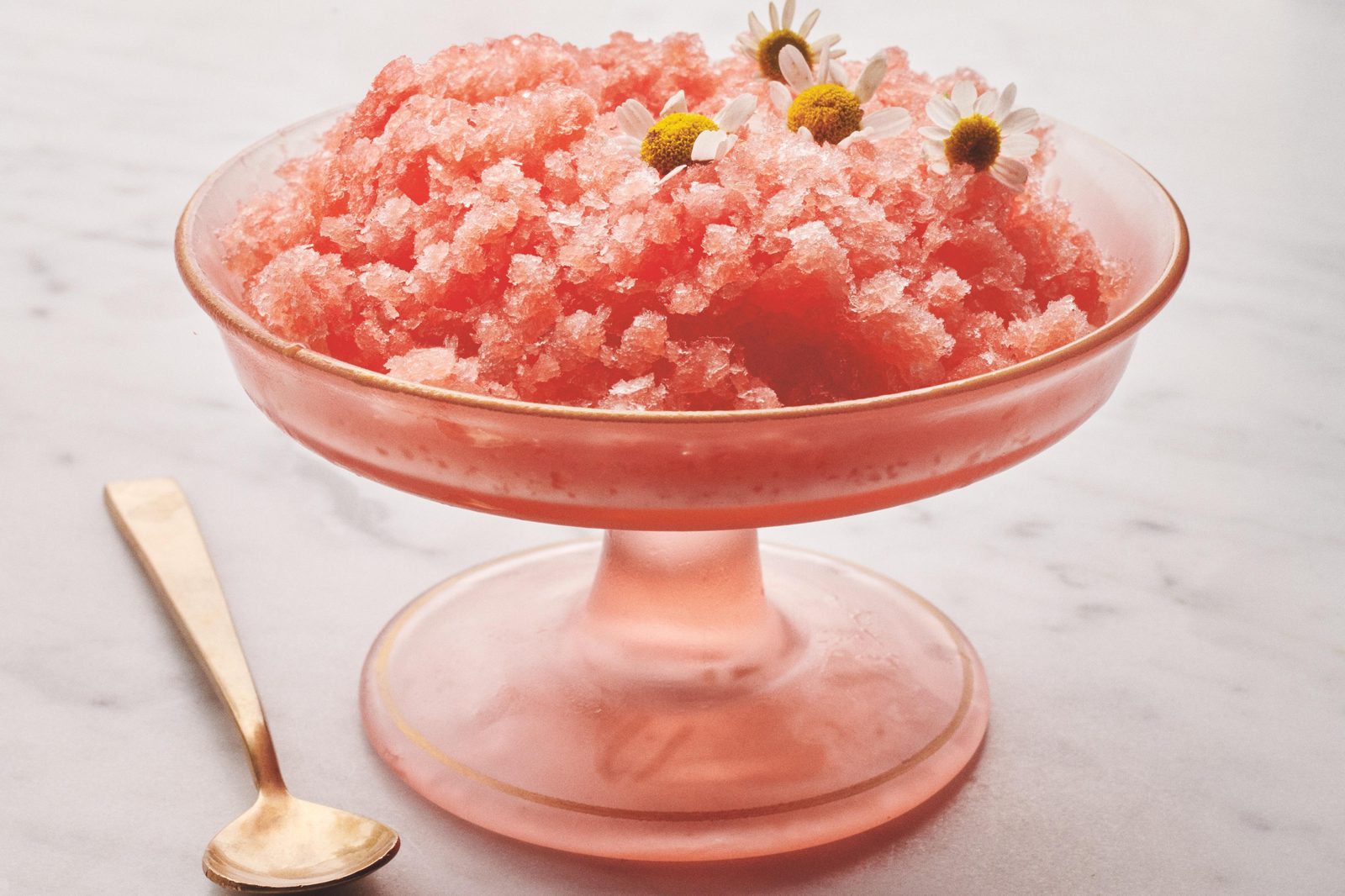
Why Granita, Not Gelato
A barbecue in July rarely calls for a custard that demands an ice-cream maker and a tempering chart. Granita stakes out the opposite ground: a 6-cup mound of diced seeded watermelon, the juice of one lemon, and ⅓ cup granulated sugar, blitzed on high for exactly one minute. The mixture passes through a fine-mesh sieve, then rests in a 9-by-13-inch baking pan. The baking pan is the key mechanism — its wide, shallow floor lets the liquid freeze into a thin sheet rather than a solid block, which is what makes fork-scraping possible. Pamela Anderson, who collected the recipe for her cookbook I Love You, describes the result as beautiful flaky crystals, a texture that sits somewhere between shaved ice and a snow cone, minus the syrupy cloy.
The Two-Hour Fork Method
Freeze the strained puree for at least two hours, then attack it with a fork. The motion matters more than the tool: scrape, don't stir, to break the frozen slab into separate crystals. Return the pan to the freezer and repeat the scraping every 30 minutes until the granita is wholly frozen and flaky. The timing is forgiving — a granita that sits too long can be re-scraped, and one that hasn’t set can wait. Anderson’s method is a deliberate counterpoint to the churning of an ice-cream maker, no motor required. The fork’s tines create irregular, jagged shards that read as homemade in the best sense. That manual step also means the dessert adapts to porch-side service: scrape it directly into paper cups or crystal glasses at the table, not ahead of time in the kitchen.
A Dessert Built for the Table, Not the Plate
Anderson, who calls dessert “more about being social” than about satisfying a sweet tooth, designed this dish for the tail end of a long summer meal. It serves 4 to 6, which fits a picnic table where guests are already holding a plate in one hand and a fork in the other. Served in paper cups, it survives a wandering guest; in crystal glasses, it dresses up the same table without extra plating work. The granita’s low sugar content — ⅓ cup against 6 cups of fruit — keeps it from competing with the main course, and the lemon juice cuts the watermelon’s natural flatness. It is a dessert that doesn’t demand a bowl of cream or a drizzle of sauce; the texture and temperature carry the finish.
From Recipe Cards to a Cookbook
The dish comes from I Love You, Anderson’s 2024 recipe collection published by Voracious, an imprint of Little, Brown and Company. The book began as a box of recipe cards she compiled as a housewarming gift for her sons, Brandon Thomas Lee and Dylan Jagger Lee, drawing on homegrown traditions and travel. The watermelon granita sits in a chapter where desserts are shared rather than served — meant to be pulled out mid-conversation over cards or coffee. The card-to-cookbook path explains the recipe’s directness: no obscure equipment beyond the fine-mesh sieve, no technique beyond a blender and a fork. Anderson, who identifies as a lifelong cook and homemaker, framed the project as a mother’s gift rather than a chef’s manifesto, and the granita reads that way.
The Leftover-Watermelon Solution
The recipe also solves a practical summer problem: a half-eaten watermelon past its prime. Six cups of diced fruit is roughly a quarter of a large melon, but the recipe scales easily — maintain the 6:1 ratio of fruit to sugar and the juice of one lemon per 6 cups. Overripe watermelon works fine, since the blender and sieve don’t care about texture, only sweetness. The lemon brightens the flavor without adding water, which would dilute the crystals. The granita keeps in the freezer for days, though Anderson’s method assumes you’ll scrape it right before serving. A batch left unscraped turns into a solid slab — revive it with a few extra minutes at room temperature and another fork pass.